
Table of Contents
- What Are Synthetic Fragrances and Why They Trigger Headaches
- The Science: How VOCs and the Trigeminal Nerve Cause Head Pain
- Fragrance Sensitivity Symptoms: From Migraines to Respiratory Irritation
- How to Identify Synthetic vs Natural Fragrance on Labels
- Non-Toxic Home Fragrance Alternatives for Sensitive Noses
- Workplace Accommodations and Reducing Chemical Exposure at Home
- The Psychological Toll of Fragrance-Induced Chronic Pain
- Conclusion: Taking Control of Your Indoor Air Quality
- Frequently Asked Questions
Last Updated: September 30, 2026
What Are Synthetic Fragrances and Why They Trigger Headaches
Synthetic fragrances are lab-created scent compounds that mimic natural aromas, and synthetic fragrances headaches happen because they release volatile organic compounds (VOCs) that irritate the nervous system. This guide breaks down the science behind why synthetic fragrances cause headaches and what you can do about it.
If you've ever felt a dull ache bloom behind your eyes minutes after walking past a candle aisle, you're not imagining it. The American Lung Association on fragrance and indoor air notes that scented products can release dozens of chemicals into indoor air, and for sensitive people, that cocktail lands hard.
Common Ingredients: Phthalates, Synthetic Musk, and Masking Agents
Phthalates are chemicals used to make fragrance last longer on skin and in the air. Synthetic musk replicates the warm, animalic base notes of natural musk at a fraction of the cost. Masking agents are added to hide the smell of other chemicals in a product, which means a single "fresh linen" candle can contain a blend of dozens of unlisted compounds.
How Synthetic Chemicals Differ from Natural Extracts
Natural extracts come from plants: essential oils pressed or distilled from flowers, bark, and resin. Synthetic versions are built molecule by molecule in a lab. The key difference isn't "natural good, synthetic bad" as a blanket rule. It's that synthetic blends often contain petroleum-derived compounds and undisclosed mixtures that the olfactory system and trigeminal nerve can react to more aggressively.
The Science: How VOCs and the Trigeminal Nerve Cause Head Pain
VOCs are carbon-based chemicals that evaporate into the air at room temperature, and they cause head pain by irritating nerve endings and triggering inflammatory responses. When you breathe in a synthetic fragrance, those compounds travel straight to your nasal passages, where they meet the trigeminal nerve.
Volatile Organic Compounds, Neuro-Inflammation, and Vasodilation
The trigeminal nerve is one of the largest cranial nerves. It carries sensation from your face, sinuses, and nasal cavity to your brain. When VOCs hit it, the nerve fires signals that can produce neuro-inflammation and vasodilation, the widening of blood vessels. That widening is what many people experience as a throbbing, pressure-like headache.
Trigeminal Nerve Activation and Sensitized Airways
Repeated exposure can leave the nerve and your airways in a sensitized state. Once sensitized, even small amounts of an odorant can set off a reaction. This is why someone who once tolerated scented detergent may suddenly find it unbearable.
Fragrance Sensitivity Symptoms: From Migraines to Respiratory Irritation
Fragrance sensitivity symptoms range from tension headaches and migraine attacks to sinus irritation, coughing, and skin reactions. The symptoms vary widely because the trigeminal nerve, respiratory tract, and immune system can each respond differently.
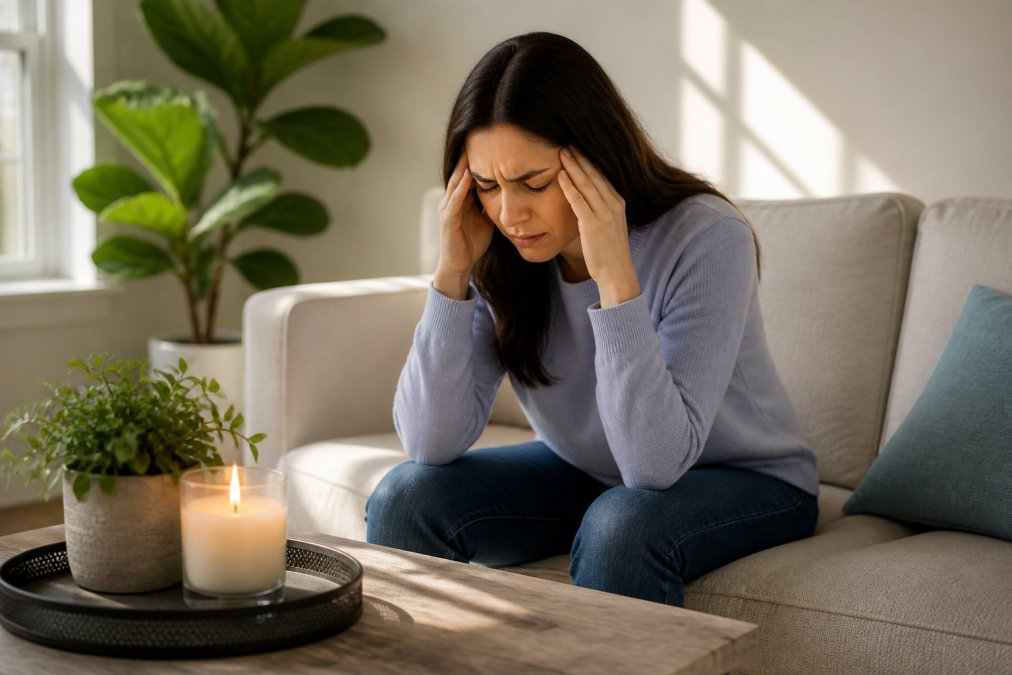
Neurological Symptoms: Tension Headaches, Migraine Triggers, and Chronic Pain
For some people, a synthetic fragrance is a reliable migraine trigger. Others get a low-grade tension headache that lingers for hours. A smaller group develops chronic pain patterns where the nervous system stays in a heightened state long after the scent is gone.
Physical Reactions: Sinus Irritation, Bronchospasm, and Allergic Reaction
Physical symptoms include sinus pressure, a runny nose, and in more serious cases bronchospasm, a narrowing of the airways that makes breathing difficult. True allergic reactions to fragrance are less common than irritation, but they do occur, often showing up as contact dermatitis or hives.
| Symptom Type | Common Signs | Typical Trigger Route |
|---|---|---|
| Neurological | Tension headache, migraine, brain fog | Inhalation |
| Respiratory | Sinus irritation, cough, bronchospasm | Inhalation |
| Skin | Hives, redness, itching | Direct contact |
| General | Fatigue, nausea, dizziness | Inhalation or contact |
How to Identify Synthetic vs Natural Fragrance on Labels
The fastest way to identify synthetic versus natural fragrance is to look for the word "fragrance" or "parfum" on the ingredient list. Under federal labeling rules administered by the Food and Drug Administration (FDA), companies can use that single catch-all term to represent a blend of dozens, sometimes hundreds, of chemicals without disclosing them individually.
Here's how to read a label more carefully:
- Scan for "fragrance," "parfum," "aroma," or "natural fragrance" as catch-all terms
- Check for "phthalates," "diethyl phthalate," or "DEP"
- Look for "synthetic musk" or "musk ketone"
- Note "masking fragrance," "odor neutralizer," or "perfume"
- Prefer products that list individual essential oils by name
- Treat "unscented" as different from "fragrance-free"
The 'Unscented' vs. 'Fragrance-Free' Trap
This is the single most common labeling confusion, and it trips up even careful shoppers. Unscented typically means a masking agent was added to cover the smell of the raw ingredients, so the product may still contain fragrance chemicals, just ones engineered not to smell like anything. Fragrance-free means no scent was added at all, though a product can still contain a preservative or ingredient that has a faint natural odor.
A few practical rules:
- "Unscented" is a marketing claim, not a safety guarantee. Read the ingredient list anyway.
- "Fragrance-free" is the safer default if you're sensitized, but verify no "fragrance" or "parfum" appears in the list.
- "Natural fragrance" is not automatically safer. It can still be a blend of essential oils and isolates, and some, citrus, mint, eucalyptus, are potent trigeminal nerve activators.
- "Hypoallergenic" and "dermatologist-tested" say nothing about fragrance content. They are not regulated terms with fixed definitions.
Where to Check Beyond the Bottle
Fragrance hides in places people rarely think to look. Laundry detergent, dryer sheets, fabric softener, dish soap, surface cleaners, air fresheners, plug-ins, scented trash bags, and even some paper products all carry fragrance. If you're trying to isolate a trigger, audit every scented product in your home, not just the obvious ones like candles and perfume.
Non-Toxic Home Fragrance Alternatives for Sensitive Noses
Non-toxic home fragrance alternatives include unscented candles made from soy or beeswax, essential oil diffusers with single-origin oils, simmer pots with citrus peel and spices, and good old-fashioned ventilation. The goal isn't to eliminate scent from your home. It's to choose scents your body can process without a reaction.
Workplace Accommodations and Reducing Chemical Exposure at Home
Workplace accommodations for chemical sensitivity are more common than most people realize, and in many cases you have more leverage than you think. The key is to frame the request around your ability to do your job, not around a preference for how the office smells.
How to Ask for Accommodations at Work
Start with a conversation with HR or your manager, and put the request in writing so there's a record. A few practical asks that tend to get approved:
- Switch shared cleaning products to fragrance-free versions
- Move your desk away from heavily scented common areas, restrooms, or entryways
- Designate a scent-free zone or meeting room
- Ask that plug-in air fresheners and scented candles be removed from shared spaces
- Request a fragrance-free policy for common areas, similar to existing smoke-free policies
Reducing Exposure at Home
At home, the changes are simpler and largely within your control:
- Switch to fragrance-free laundry detergent, dryer sheets, and fabric softener
- Ventilate your kitchen and bathroom daily, and open windows when weather allows
- Store scented products, candles, sprays, plug-ins, in sealed containers, ideally outside living areas
- Choose beeswax or soy candles over paraffin
- Run a HEPA air purifier in the room where you spend the most time
- Wash new clothing and bedding before use, since finishes and fragrances linger from manufacturing
The Psychological Toll of Fragrance-Induced Chronic Pain
Chronic pain from fragrance exposure carries a psychological weight that rarely gets discussed. People who react to everyday scents often describe feeling hypervigilant, anxious in social settings, and isolated when they have to leave a room, a meeting, or a friend's home because of a candle or a coworker's perfume.
Conclusion: Taking Control of Your Indoor Air Quality
The link between synthetic fragrances headaches isn't a fringe theory. It's a documented interaction between VOCs, the trigeminal nerve, and the body's inflammatory response. If you're tired of choosing between a nice-smelling home and a clear head, there's a third path: fragrance that's crafted with care and transparency.
Frequently Asked Questions
Why do I get headaches from fragrances?
Synthetic fragrances release volatile organic compounds (VOCs) that can irritate the nasal passages and activate the trigeminal nerve, a major pain pathway in the face. This activation leads to neuro-inflammation and vasodilation, which many people experience as a headache or migraine. Those with chemical sensitivity or sensitized airways react to even low levels of these odorants, making indoor air pollution from scented products a common trigger.
What are the most common fragrance sensitivity symptoms?
Fragrance sensitivity symptoms include tension headaches, migraine attacks, sinus irritation, respiratory irritation, and skin reactions. Some people also experience neurological symptoms like dizziness, brain fog, and nausea. If you notice these symptoms repeatedly after exposure to scented candles, air fresheners, or cleaning products, you may have chemical sensitivity and should track your reactions to identify specific triggers.
How can I switch to non-toxic home fragrance alternatives?
Start by choosing products labeled fragrance-free rather than unscented, since unscented items may contain masking agents. Look for candles made from soy or beeswax with essential oils, or use a simmer pot with natural ingredients. Always check for full ingredient lists and avoid phthalates and synthetic musk. Non-toxic home fragrance alternatives support better indoor air quality and reduce chemical exposure.